index
On Becoming an Artist | Look Back | s*ssy caption aesthetic II | Girl Purgatoriem | good writers are perverts | EROSTASIS | 17776
On Becoming an Artist
Meonggae of The Tide Pool
i’ve been thinking a lot about what it means to have a “creative output” recently, namely out of fear that i don’t have one. this is a fear that returns to me every so often. i get no joy from painting, illustration, modeling; although i can play an instrument, making music is not something i find rewarding; video editing is maddening to me; you name it, i’ll reject it until we’re left with writing.
it’s interesting that i conceptualize of my “thing” as writing, considering it’s not something i’ve done a lot of in my life. certainly i read a great deal as a child, piles and piles of books from the library exchanged for piles more every week with my mother, but that stopped when i got bored of the fourth installment in a series about a certain boy wizard which need not be named. besides, Homestar Runner and Club Penguin were awesome and i was way too busy surfing the web for flash games to read books or think about writing my own story. when i wrote, it was out of necessity for school. when i was told i was good at it, i did not consider writing for pleasure. several pieces of my schoolwork were submitted to scholastic competitions and won, and still i did not consider writing for pleasure. (the competitions hurt more than anything. i wasn’t proud of my “what i did for summer vacation” essay, i was told to write it and so i did. it was a statement of fact. who cares? nobody ever explained to me what made it so exceptional.)
writing for pleasure was something that i did for a brief few years in middle school and high school. it was a lot of erotica and some fan fiction for the games i really liked at the time, occasionally poetry and original fiction. i was never drawn to worldbuilding. when dysphoria-induced depression started really kicking my ass, this impulse died save for suicide note drafts. being around queer people has meant hearing a lot about how important it is that we Make Art (and that if you think you can’t you should do it scared or do it bad). now i feel the urge to create and i want to take advantage of the one creative skill i have, but i have no desire to write fiction. is that still art? is this creative? does talking about feminism, or complaining about how a work is less interesting than it could have been because of its misogyny, “count” as creative? i only ask because all these do it scared types seem to imply the answer is no, it doesn't!
i found this piece by accident during the period of time i was looking for answers to that question, and it doesn’t answer it! if anything, the continued lack of any reference to analysis-as-creation stung to read. it did reinforce in me that “you need to play” (p. 18), although i prefer what my good friend calls it: "eating & shitting." you need to ingest all sorts of works of varying media, genre, tone, even quality, things you hate and things you love, and once you've had enough to eat you won't be able to help but shit your creation. the fact that i wrote and published both Feet I and Asexual I with such relative ease compared to my old writing process is all the proof i need. although i think a number of the works below have severe flaws, Feet I is shaped by at least an element of every single one of them. back to top
Look Back
dir. Kiyotaka Oshiyama
recommended explicitly and glowingly in On Becoming An Artist, i watched Look Back immediately after reading the former. i’m not normally one for watching movies alone, but Concerta has slowly helped me change that, and it didn’t hurt that i knew it was shorter. it’s really sweet! i got a solid cry out of it, and despite this being my first introduction to Fujimoto’s work i already agree that she’s gonna figure it out sooner or later, wink wink.
i love the depiction of Fujino’s year of obsessive practice. for one, it made me think about how i can write more in the first place, to get the necessary practice in - an idea also covered in On Becoming an Artist. but where in my busy schedule could i possibly fit that? when i wanted to read more, i brought a book with me everywhere so i could open it anytime i was waiting in line, sitting on hold, or otherwise had nothing to do. it worked great, but you can’t really write anywhere the way you can read anywhere unless you’re tapping on your phone, which hurts my hands. the answer came to me the next morning at my office computer: fuck work!!
of course, the point wasn’t the practice, but how she didn’t need to improve her art by leaps and bounds in order to have work that was worth sharing, that left an impact on others - including on someone whose work she thought was objectively superior to hers! i have a bad habit of studying difficult tasks so i can avoid practicing them, and there was a time where i tried to do this in preparation for writing fiction. i studied how different authors outline and edit and worldbuild and make characters, all because i thought there was some baseline i had to meet before putting my work in front of others.
unusually for me, i realized pretty quickly that the approach wasn’t working and put the project of writing down. now years later and in search of a new approach, Look Back planted the seed in me that “the baseline” is bullshit, and the breadth of the titles that follow germinated it. it’s one thing to know that publishing anything is better than publishing nothing, but it’s another thing to see and enjoy the anything that others are publishing!
also, i like how often Fujimoto depicts his characters with their mouths agape. back to top
s*ssy caption aesthetic II
Bagenzo
i actually remember the chain of events that led to me reading this. Mentha Nolana reposts Bagenzo’s post about smilejam > Bagenzo recommends her windowpane engine for the jam > this has the most eye-catching title of the windowpane example games.
i guess what surprised me most is that this is just an essay! it sounds silly but i had never considered using a game engine or an interactive medium to just… talk. and have people love it! prior to this game (or collage, as it calls itself before you press play), the closest thing to that idea i could think of was a walking simulator, which still requires more skills than i currently have - level design, art design, asset creation. the only difference between this game and this post is that this post doesn’t require HTML5 (and also that i’ll never post a selfie on here).
Bagenzo’s analysis is cutting and her aesthetic sense really appeals to me - no surprises that i’m enraptured by tacky gifs, crunchy compression, and a cynical look back on the specific kinds of transmisogyny that pervaded the early internet so intensely. fuck, i’m so glad we have the language to talk about this now, to call attention to it as wrong and harmful. i’m loathe to imagine another generation of girls spending their teenage years watching men argue if traps are gay - sorry, they call us femboys now.
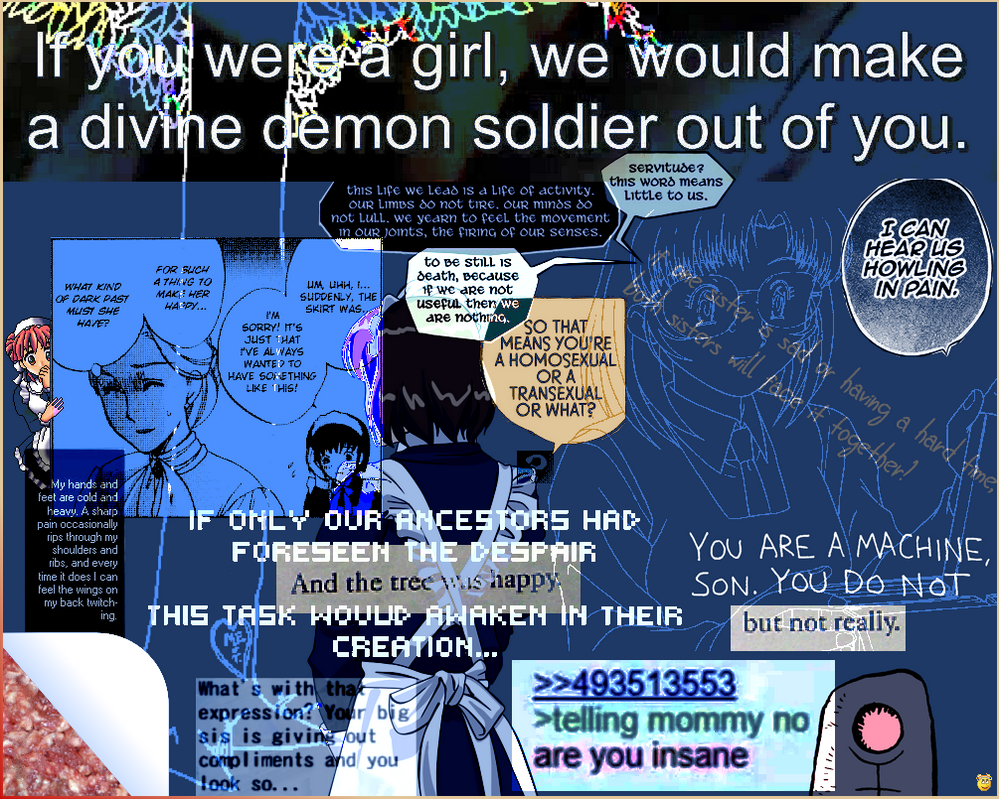
"when i look back at all the people who’ve helped me... i realize very few of them were able to help me materially. they were open and honest about themselves in a way i don’t think i can ever reach."
reading this blew everything open for me. i’m familiar with a lot of the arguments, i share many of her positions, and i differ from her on others. that’s not the point. even if what she has to say isn’t anything especially new to me, the way she writes about it and presents it is more than compelling enough for me, and that made me realize two things. one: this is the answer! essays are creative, nonfiction is creative, analysis is creative, it’s a joy to read and a joy to write. while revisiting the game during the writing of this post, i even discovered that essay jams are a thing on itch! holy shit!! two follows from one: if i can feel moved in some way by this weird thing, isn’t it possible someone could be moved by my weird thing?
i look forward to experiencing much, much more of Bagenzo’s work. she’s a prolific creator - including, i now realize, of a template i considered using for this very site! - and she writes about things i care about in a way i care about. that’s a treasure for me. don’t be surprised if i have less to say on s*ssy caption aesthetic I, but i will be reading it soon. back to top
Girl Purgatoriem
Blood Machine and 773tk
i told several people when i published it that Feet I is inspired by visual novel dialog, and you have Girl Purgatoriem to thank for that. banned from itch.io, two sisters kill and frot their way through the end of human civilization for the amusement of their betters. i know it doesn’t take much to get banned from itch anymore, but it’s still a pretty reliable marker of a game made by my kind of transfem. i went in with high hopes and felt a little disappointed. where s*ssy caption aesthetic II was familiar but compelling, this is familiar and not compelling, i’m sorry to say.
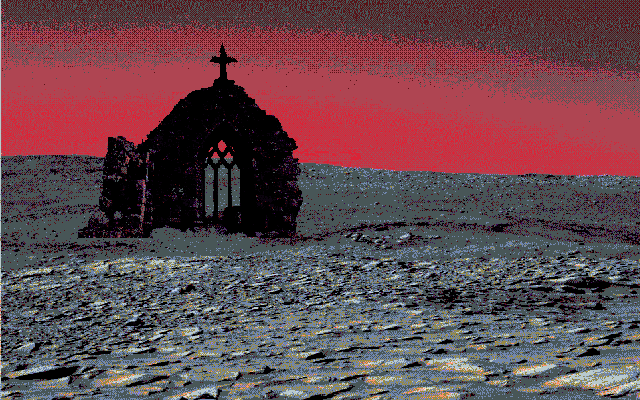
the good: audiovisually, the game is extremely appealing. i locked in as soon as i saw the custom RenPy UI load. three simple, well-crafted music tracks fit the mood every time they’re employed, plus the game knows when to leave matters silent. i suspect many of the backgrounds are modified from photography and existing art, and i simply adore the way it’s done. the desaturated color palette and dithering are unforgivingly bleak. i know in a sense that this is how many indie VN backgrounds are made, but this is the first time i've noticed that it was the case and still felt really taken by that art. there are five excellent CGs, including one that’s only shown for a fraction of a second, as well as a short animation - it feels like a lot for such a short runtime. i love how heavily scarred the girls are depicted, with some being more obviously battle scars than others. i think the intended vibe was PC Engine; either way that’s what i’m getting heaps of, and i love it.
ever since i discovered VN author Nadia Nova, who has made it a mission of hers to convince people they can make VNs, i've had a latent desire to prove her right, but i always stop myself. how will little old me manage compelling background art, character art, a decent UI, music and sound? with every VN i play, i feel puzzle pieces rearranging in my brain, getting closer and closer to a finished picture. with Girl Purgatoriem, the last piece labeled background art found its place and clicked in securely.
well, that’s most of what makes a visual novel, isn’t it? but it’s the writing that left me wanting. even as someone who’s not a living weapon aficionado, a friend of mine pointed out that i’ve read an above-average amount of transfem living weapon allegories, and this is much like the rest. the angels are too useful for society to be without them entirely, yet too similar to the beasts they slay to be full people. angels who are too true to themselves, ask for too much, are traumatized until they stay in line and then kept either until they break from the pressure or they stop being useful, whichover comes first. i can’t even call it blunt, it really tries to be nuanced, but it just isn’t novel for me in any way, and there’s not enough to the worldbuilding to keep me engaged from that direction. it’s short, i would say it doesn’t overstay its welcome, but... i wish it had, in a way. i wish the authors had tried to explore more of the field they laid before them.
i’ve caught some flak for saying this in the past, but i can’t help it: egregious, stylistically incompatible typos bother me, especially when they appear during thematically and emotionally important scenes. this game has the same typos appear twice during its most important sequences. the characters are also quite literally clones of one another - as in, it’s justified in the plot and thematically. i don’t have a problem with that necessarily, but without an earlier explanation of which one has the eyepatch, it made telling the difference between Arakiel and Machkiel extremely difficult throughout.
a beta reader told me that reading my opinion on this game made them not want to play it, which i feel bad about and have tried to amend for publication. my point isn't to shoo you away from the title; this is a bibliography, not a review. i think what the game does effectively it does very effectively. those elements of the game are worth studying and taking inspiration from, but so are the elements i felt were missteps. not only will everyone who comes to Girl Puragtoriem have a diferent experience with transfem storytelling from mine, but even if you leave feeling similarly disappointed, that still teaches you something about what you want to see made, doesn't it? back to top
good writers are perverts
Domino Club
it’s true! i’ve been realizing it more and more recently, but this work makes the case really succinctly for perversion as both an expression and genesis of unbridled passion, and for unrestrained passion as the essence of interesting. a friend of mine shares her art with me pretty regularly; i suppose you wouldn’t be wrong to call it “fetish art” necessarily, but increasingly i dislike how reductive that is. it calls attention to how its content sets it apart from other art, which is inherently addressing it as unlike other art, perhaps even unlike art. is it not good enough to enjoy the work for what it gives you? must we be careful not to touch it until we say wait! before we risk forming an emotional attachment to this, we must address my assumption that it gave the artist a boner? come the fuck on. i don’t need the fiftieth reminder that Sinkdog is “fetish art,” she’s literally cutes.
i keep seeing clips of this game, MOTORSLICE. i can tell it wasn’t made by perverts. sure, you can make her step on the camera with her combat boots, and she gets sweaty, and you can sniff her bare feet or whatever. good writers are perverts points out, as i would like to more directly, that that the inclusion of fetishes is not perverted by necessity. this is easier now that feet are mainstream, as i’ve established, but every nominal perversion in the game is only included with the patriarchically-appropriate measure of indulgence. the game includes these elements cynically, for buzz, for Twitch clips and Instagram reels of people reacting to getting the protagonist to do an ahegao face in the selfie mode, because “you know it’ll cause a stir when you tell the boys.” the developers call it what it is on the game’s Steam page: fanservice.
if you took away the text and the painfully cutesy voice acting (my issue is the direction, not the actress), you would still be able to tell that the foot fetish scene is a joke because of the quality of the model. it's not bad, it's not ugly. but a 3D modeler who jacks it to feet pics would have rendered her feet more lovingly, even under the constraints of the pseudo-5th gen art style. a higher arch, a more defined ball, a slimmer heel, the big toe would be fixed. what’s shown was made by a modeler who paid a little more attention because they were told there'd be a scene where they show off her feet.

you're not fooling anyone. screenshot of MrJokujo's YouTube video.
MOTORSLICE was made by some of the most sexually normative people you can imagine, for the most sexually normative people you can imagine. while looking for the foot fetish clip on YouTube, i saw someone playing the game live, their stream titled “playing with my favorite chainsaw waifu.” if the mention of the phrase “ahegao face” didn’t do it for you earlier, that last word should be all the confirmation you need.
when i’ve burnt out from writing in the past it’s been because there was some invisible standard i was holding myself to. critiques should have this structure, i should maintain a professional style, whatever i’m doing there’s a right way and a wrong way that someone else defined and i’m doing it the wrong way. that’s always caused friction for me because when i talk about stuff with my friends i’m often so verbose, so passionate and unrestrained - then it comes time to make the spoken word written, and with it the English class expectation of dulling that passion with professionalism. no, the right way is the way that feels right for me: all lowercase and blithe, refusing to deny myself my fascinations. the right way is the way that gets me to write things, because something that got written has infinitely more value than something that didn’t get written. and look at me! i’m writing! i’m enjoying myself, i’m proud of myself!
the wrong way is what gets games like MOTORSLICE made. back to top
EROSTASIS
candle and Beck Michalak as SYSTEM SLUT SOFTWARE (Domino Club)
EROSTASIS is a gruesome, perverted, sci-fi Meet’n’Fuck-like that takes place on an automated biomechanical spaceship in some far-flung future. humans provide not just the energy for the ship, but also “automation”: the various ship subroutines are augmented humans, permanently integrated with the ship. the mechanical parts are fine, but it’s these lingering human components of the ship and their irrepressible emotional needs which need fulfilled and maintained. this sets the stage for you, a recently fabricated biomechanoid, to meet'n'fuck the subroutines. it is an appropriately uncomfortable experience throughout.
but it's also porn, and i think that's why it's stuck with me the most of the games listed here. it may be offputting, it may be unsettling enough that replaying it late at night set me a little on edge. it may even be that deriving pleasure was not a consideration of the developers at all (though i doubt it). but it is porn nonetheless, and it does titillate - haemoponics and ventilation in particular got to me, and i don't even like breathplay. "porn" is not a category we should run from; let none say that pornography can't be enjoyed for any reason other than pleasure, that pornographic media can't effectively explore themes or impress aesthetically even while it titillates. the worst implication made by people who oppose "unnecessary sex scenes," porn as art, or kink as a way to explore humanity (an impulse that frustratingly gets misdiagnosed as simple "puritanism") is that sex is apolitical by nature - fools!
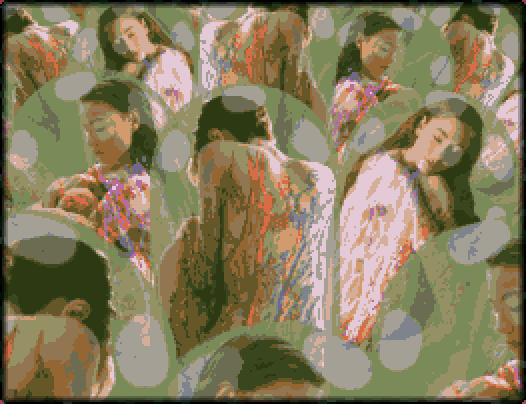
"CAPSULES? COMPONENTS? CATTLE?"
what a horrific artstyle. it feels almost impossible not to invoke Giger if you’re fucking a scary spaceship, even if the xenomorphs are missing (thankfully the trans women are not). looking at the sample made by candle for the game’s engine, tape window, it looks like this crunchy cyberpunk construction comes naturally to her. more immediately to me than Giger though is a DOS point-and-click horror game. i get them all mixed up, so i had to look it up and was surprised that i wasn’t thinking of Dark Seed, one of Giger’s own works, but Harvester. it’s how out of place every human looks, i think, that gives it a hint of that composited FMV look.
oh, god, the audio. i can’t praise (or criticize) the writing without mentioning the audio. by far the strongest thing EROSTASIS does is punctuating every word in its short, pointed, deliberate sentences with a grinding sound effect, plus a different one for the end of the sentence. each character gets their own set. so much gravity and filth is added by the authors choosing to work around this simple strength. it is inspirational and makes me want to explore tape window all on its own. the music, too; electricity grates, biomass bubbles, set against a genuinely Yamaoka-like atmospheric hum and whirr, it’s all so overwhelming.
perhaps true to its Meet’n’Fuck predecessors, not all of the encounters are fulfilling. navigation, a sadism scene, is underdeveloped all around, from its motivations to the execution of the “sex scene” itself, owing to the lack of dialog. although i come to these works with an open mind, i can’t help but imagine if i would have liked the bioremediation scene better were i one for wet and messy or encasement. maybe, but i doubt it - owing to the scene’s excess of dialog. most frustrating for me was the ending: as well written as it was, the sound effect that plays right at the moment the main character is snuffed is... a little silly. i have the littlest bit of a snuffdoll streak. it is not that hard to construct a scene that’s satisfying to me, and this was not that. in a game this specific i find that a little hard to believe for its ending, and i wonder if i’m simply not the audience; if you expand the list of perversions on the game page, “oblivion” is the penultimate kink (next to inflation, of course). back to top
17776
Jon Bois
i love Jon Bois’ writing so much. his style has been an inspiration to me ever since someone first showed me Breaking Madden as a teenager and i was starstruck that his Super Bowl editions were named after Godspeed You! Black Emperor lyrics. the word i might use is scrappy - you don’t have to give him much, but when he’s presented with an account of real-life events he has an uncanny ability to find the dramatic throughline in them. who else could make a series like Chart Party consistently interesting? and on top of that, he’s a child of the internet with the good sense to assess what “the internet” permits and workshop the best. this word has been getting abused lately, but i mean it when i call him a generational talent. so when i found out he had published multimedia original fiction and people were absolutely going bonkers over it, of course i knew i had to read it!
i can’t believe that was nine years ago. i’ve read it now, and it’s fine. it’s okay. i don’t think Bois is especially good at dialog, and this is all dialog. it’s not bad or unrealistic necessarily - maybe the pacing of it is the problem. maybe the pacing of it all is the problem. it’s hard for there to be any stakes in a story where no one can die or be injured and people are largely nice to each other. he tries to introduce stakes, but it doesn’t land, for me. and i was so on board! the fakeout into the intro, where the dialog and the vast expanse of calendars really sell the feeling of desperation and loneliness and confusion because you didn’t even know that loneliness was a thing that exists or that you can feel and now you’re overwhelmed - genuinely admirable. Ten is developed really strongly here before becoming more or less a device (lol) that Bois can point in a direction and make ask questions about an idea, and it feels like a waste.
Bois tries to juggle three different narratives at once from here, with characters that are less strongly developed than Nine, Ten, and Juice, and none of them move in an interesting direction, for me. i think 17776 is one of those things a fancy critic who liked it would call a “meditation” - which is to say it doesn’t serve a narrative per se but instead explores its themes through mood. well, i don’t think it did that very interestingly, either, so i’m a little stuck. his style fits the narrative, the Google Earth abuse (i mean this with genuine respect) and newspaper clippings, but it doesn’t feel like he pushed it especially far in comparison to his other works at the time.
i intend on reading 20020 at some point, i hear it’s pretty different aside from the POV being the satellites again, but i’ve got more strange transgender visual novels to read first. back to top
you will note that this is out of order from the bibliography on the article. heh heh heh. there are narratives everywhere for those with the eyes to see them!